When the Balance Tips


The problem does not always lie in the great things, but in things being placed where they do not belong.
Life, at its core, rests upon a kind of hidden balance: everything has its proper place, every ability has its rightful field, and every person has a space they are capable of filling with competence. When that balance is disturbed, the flaw may not reveal itself immediately, but slowly it begins to alter the shape of the entire environment.
The seat may appear secure, the scene complete, and the outward form perfectly ordered. Yet a picture is not necessarily right simply because all its elements are present. Sometimes the real flaw lies in the relationship between a thing and the place it occupies—between the magnitude of responsibility and the breadth of one’s capacity, between what a position demands and what its holder is truly able to give.
There are positions that do not make a person; they reveal them.
They reveal the measure of their patience, the depth of their vision, their ability to choose, and their firmness in moments when courtesy and compromise are no longer enough. In quiet times, many may appear fit to lead, but the moment of decision alone distinguishes between the person who carries the position and the person who is carried by it.
When weakness occupies a position of great responsibility, it rarely announces itself openly. It does not say, “I am incapable.” Instead, it appears as hesitation, delay, or an exaggerated fear of opposing opinions.
At times, it hides behind silence; at others, behind excessive talk. Sometimes it shelters behind rigid formalities rather than substance, out of fear for the position itself—forgetting that no position lasts forever. Had it remained forever with those who came before, it would never have reached its present holder.
For outward form is often the final refuge of those who lack sufficient substance.
A person who senses, deep within, that the space they occupy is larger than their ability may become increasingly sensitive toward others. Competence around them does not reassure them; it unsettles them. Independent opinion does not enrich them; it disturbs them. The success achieved by others may be perceived not as an asset to the institution, but as a threat to their own image.
This is why some institutions do not begin their decline with a single catastrophic decision, but with a long sequence of small choices. The capable person is excluded because they are difficult to control. The quiet and compliant person is brought closer because they do not question. Harmony becomes more important than truth, loyalty more valuable than competence, and personal security more important than the interests of the institution.
With time, the institution itself begins to change. People learn that survival matters more than initiative, that silence is safer than expressing an opinion, and that proximity to the decision-maker may be more useful than mastery of one’s work. The problem is no longer confined to a single individual; it becomes a culture in which mediocrity reproduces itself and competence is gradually surrounded and suppressed.
None of this is necessarily a moral judgment upon individuals. It is, rather, a question of suitability and proper placement.
A person may be kind, well-intentioned, and deeply loved by others, yet still be unsuited to a particular responsibility. The tragedy begins when we confuse a person’s goodness as a human being with their fitness for every position. Kindness does not equal leadership. Loyalty cannot compensate for a lack of experience. Good intentions are not enough when the lives, rights, and futures of others—and the fate of institutions—depend upon a decision.
True wisdom is not to give people whatever they desire, but to place them where they are most capable of succeeding.
When something is in its proper place, it appears so natural that we hardly notice it. But when it is placed where it does not belong, everything around it must begin exerting additional effort merely to compensate for the imbalance.
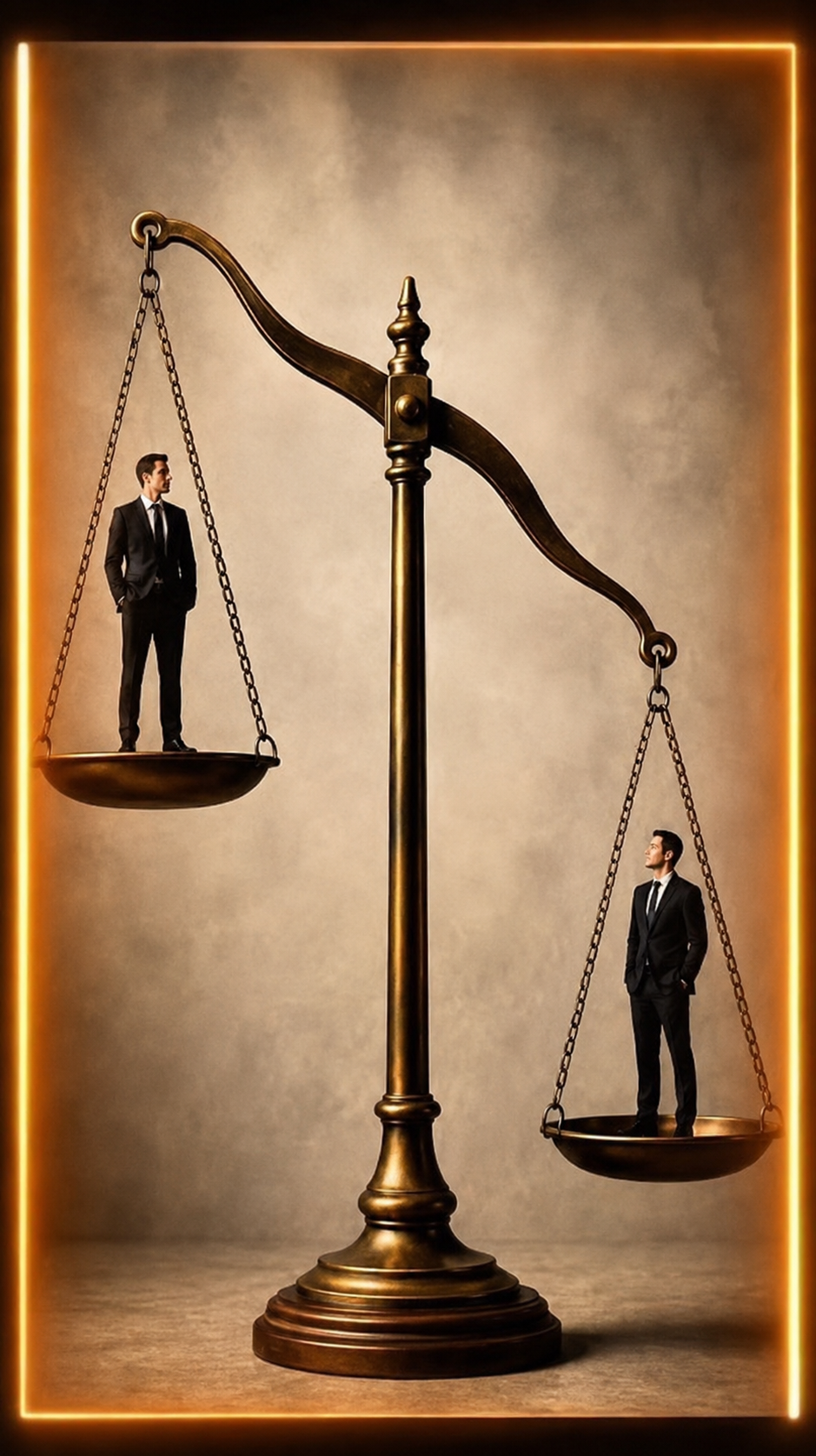
At that point, the problem becomes deeper than one person occupying one position. It becomes the problem of a scale that has lost its balance. For when positions are not granted according to merit and ability, institutions pay the price of courtesy and favoritism, while society pays the price of silence.
How many places need no additional people at all, but simply need everything to return to its rightful place.
A great position does not become smaller when occupied by someone smaller than its demands...
But everything around it begins to shrink