I Will Return One Day to the Nile Shore: Narratives of a Displaced Person from Khartoum
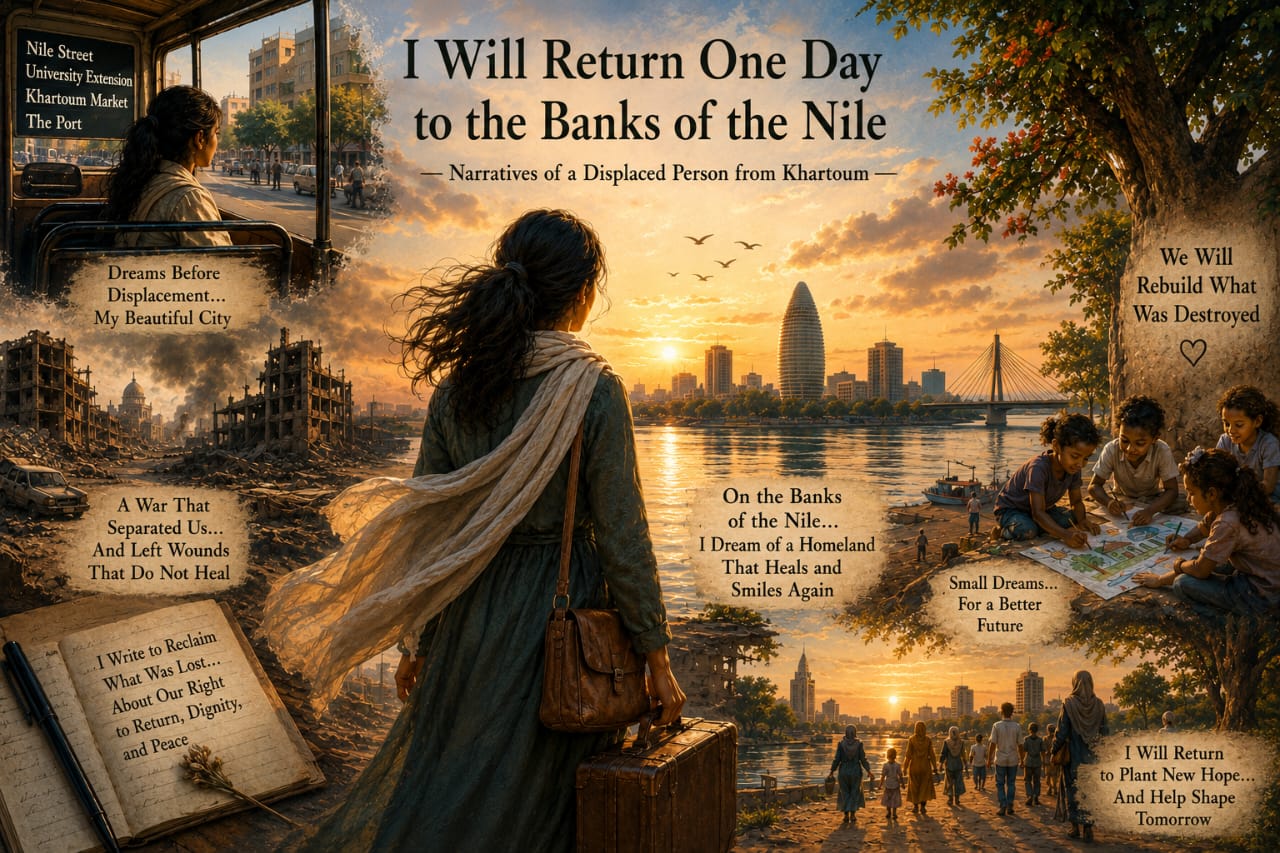


I want to be that girl who chases her dreams with the same passion she had before displacement—when she would
wait for dawn with eager anticipation, dress up, and leave for work in the early morning hours. She would ride
the carriage and sit by the window, watch the details of her city, memorize the faces of passersby, and weave her dreams to the rhythm of everyday life.
But my city is no longer the city I once knew. The hand of destruction has passed over it, and its features have changed under the burden of war.
Yet in my imagination it remains the most beautiful city to have inhabited my memory, and I keep whispering to it: rise up for all who loved you,
and for all who carried you in their hearts wherever they went.
I will return one day to the Nile shore.
I will return carrying an old wound, the sound of the home we left behind, and the scent of the earth that clung to the soul
Khartoum is not merely a place; it is part of identity, a memory stretching through the details of a life.
On distant nights I dream that I walk down a street untouched by war, I see the faces I know, and I hear the voices that accompanied my childhood.
But morning wakes me to a different reality: a city exhausted by tragedies, and people bearing the burdens of loss and longing.
I write because writing is what remains when the distance between a person and their memories tightens. I write about our right to return,
about our dream of a homeland regaining its health, and about a future we try to build despite all that has been destroyed.
On the banks of the Nile I paint simple dreams: a safe home, children laughing without fear, streets reclaiming their pulse, and a country healing from its long bleeding.
But returning after years of absence is not easy. It is like the return of a fighter worn down by battles, who comes back seeking
peace rather than victories. When I stand before the Nile I will find myself asking: how do I begin the story? Which part of the pain should I write about?
Do I write about the houses we lost? Or about the dreams that halted midway? Do I write about the person the war changed, or about the homeland that still bleeds in silence?
I have many stories to tell: tales of departure, fear, and waiting, and stories of people who carried their homelands in their small
suitcases and moved on. I also have many questions still suspended in the space of our souls: how will dreams rise from beneath
the rubble? And how will calm return to hearts that have lived through all this pain?
Despite everything, hope remains present.
The Nile still runs, memory still keeps the most beautiful of what was, and the homeland, no matter how deep its wounds, is capable of restoring its health one day.
For this I say it with unwavering faith:
I will return one day to the Nile shore, not to search for the past, but to take part in making the future. I will return to plant new
hope in a land that has known long pain, and to witness with my fellow countrymen the birth of days that are safer, more peaceful, and more just.
Only then will Khartoum find its way back to life.
—But, my city, do you see the sadness of parting in my eyes? Do you feel the pang of regret for losing me all those years?
Do you sense my dreams slipping through my fingers that still keep watch over their longing for you and for our meeting?!