Sudan Bleeds… Alone
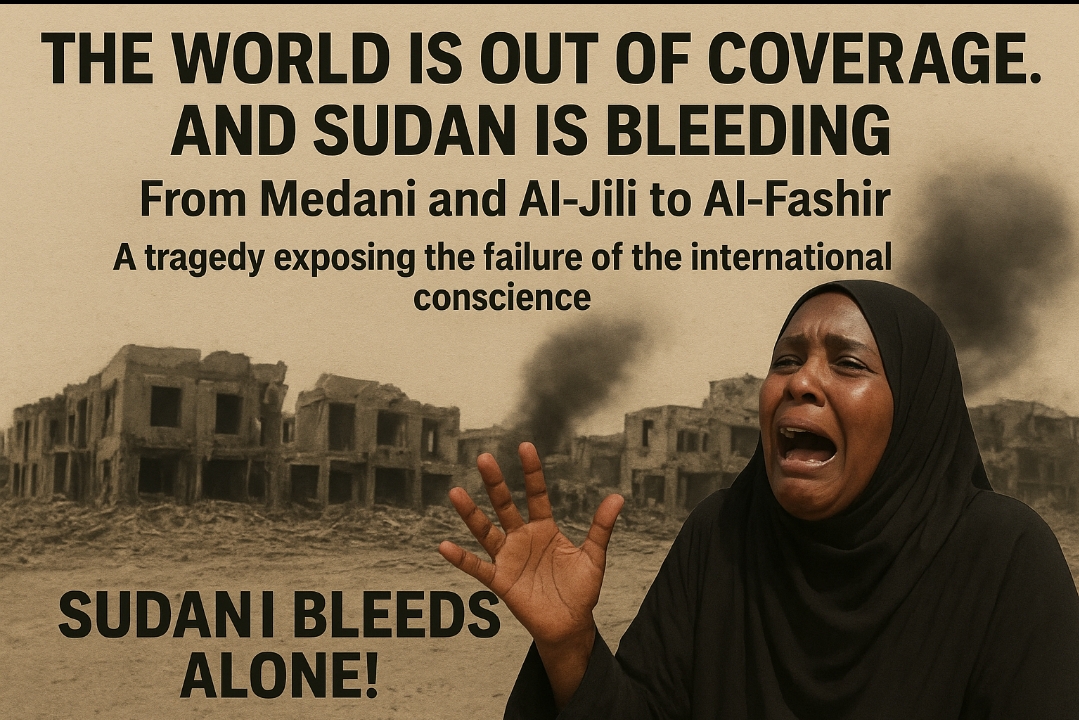


From Medani and Al-Jili to Al-Fashir: A Tragedy Exposing the Failure of the International Conscience
By: Dr. Abdelaty Elmannaee
While the world manages its conflicts through urgent calls and emergency meetings, Sudan stands alone—facing a war nearing its third year—without a single diplomatic seat shaking with the seriousness needed to stop the fighting and halt the bleeding.
Shattered streets… millions displaced… collapsing institutions… and the destruction of an entire state’s infrastructure—yet the international response remains trapped between “concern,” “condemnation,” and “calls for restraint,” phrases that neither feed the hungry nor save the dying.
When we compare this silence to the global response to other wars, the contrast becomes stark. The conflict between India and Pakistan was halted within days under intense international pressure and swift global mobilization—because the interests of the powerful were at stake.
One phone call stopped a potential nuclear confrontation. But Sudan, despite its prolonged bleeding and regional danger, appears to lack the “cards of interest” necessary to attract the world’s attention.
Did the world’s phone lines suddenly go dead when it came to Sudan?
Or has humanity simply run out of credit?
The World’s Ledger: Interests First… Humanity Last
The international community treats Sudan with an “manage the crisis, don’t solve it” mindset. As long as the bloodshed does not affect energy markets, threaten major maritime routes, or directly harm key allies, the crisis is relegated to the margins.
Slow decisions, repetitive statements, neutral committees, and donor conferences that neither return a single displaced person home nor heal a wounded child nor place a comforting hand on anyone’s shoulder.
This is how a war the size of Sudan’s is handled: through cold bureaucracy that equates victim and perpetrator, placing a national tragedy on the waiting list of geopolitical priorities.
Medani and Al-Jili… Forgotten Chapters Before the Big Explosion
Before Al-Fashir took center stage as one of the largest humanitarian catastrophes of the century, Sudan witnessed a series of bloody events that mapped the road to collapse:
Medani:
The quiet agricultural city turned into a major point of breakdown—killings, looting, displacement, hospitals shutting down, and families fleeing into the open.
Al-Jili:
Home to one of Khartoum’s most important refineries, it lived through a similar nightmare—raids, terror, mass displacement, and a total absence of international or humanitarian protection.
Between the two cities lie dozens of villages erased from global attention, though each was a clear sign that Sudan was heading toward total disintegration.
These were not scattered episodes—they were sequential warnings of a much larger catastrophe.
Al-Fashir… The City That Became a Mirror of International Failure
As the crisis entered its bloodiest chapter, Al-Fashir emerged as the open wound the world could no longer ignore.
A city under siege for years, tens of thousands of civilians under fire, blocked routes, hospitals shut down, the injured dying for lack of medicine, families escaping by night in search of a safe corner.
Scenes of mass displacement, burning markets and neighborhoods, and widespread accounts of violations—all were enough to sound the global alarm.
But the world chose to observe, condemn, and do nothing.
Al-Fashir was not just a city at war; it was a test—a revealing moment that exposed the fragility of the international system, the weakness of intervention mechanisms, and the inability of the global community to protect civilians even in their darkest hour.
Why Doesn’t the World Intervene?
The answer is painful but simple:
Because the war in Sudan has not yet reached the threshold where it threatens the interests of major powers.
No nuclear facilities.
No gas pipelines.
No vital global trade routes at stake.
And so intervention remains limited, while civilians are left to face their fate.
But the more important question is:
Can a world that claims to safeguard international peace ignore a war of this scale?
And can a catastrophe in the heart of Africa remain outside the circle of action?
Of course not.
How Does This End?
Wars do not stop by coincidence, nor do they wait for a sudden awakening of the world’s conscience. They end through three interconnected paths:
1. A Sudanese will for a political settlement
A settlement that excludes no one—the war places all under the same Sudanese flag.
A settlement to stop the bleeding and end the deadly wagers taken at the expense of civilians.
2. A genuine regional effort matching the scale of the tragedy—not the size of the global conscience
An effort that halts military support, dries up the sources fueling the conflict, and reinforces stability.
3. A firm and binding international intervention
Not statements, but decisions that assign responsibility for continued fighting and link it to an enforced ceasefire.
Isn’t the sea of blood—visible even from satellites—enough?
There is a well-known rule in the management of war:
A war ends when continuing it becomes more expensive than stopping it.
In Sudan, weapons remain cheaper than peace, and chaos remains profitable for certain actors.
Al-Fashir Is Not the End… But It Is the Final Warning
Sudan’s tragedy will not be buried unless voices inside and outside continue to rise.
Media, writing, and public pressure are tools to break the silence and remind the world that this is not a passing event—this is an extended crime.
What we write today is not a luxury.
It is documentation of dark days that must not be forgotten.
A homeland that is not defended by storytelling will be assassinated again through forgetting.
Sudan is not waiting for a miracle—it is waiting for justice, conscience, and a courageous decision that restores its people’s right to life.
Until that happens, the question remains:
Is the world out of coverage?
Or is Sudan’s blood simply not enough to recharge the interest of global powers?



.jpg)