Rivers are the arteries of civilizations. When water first wrote the opening lines of history,
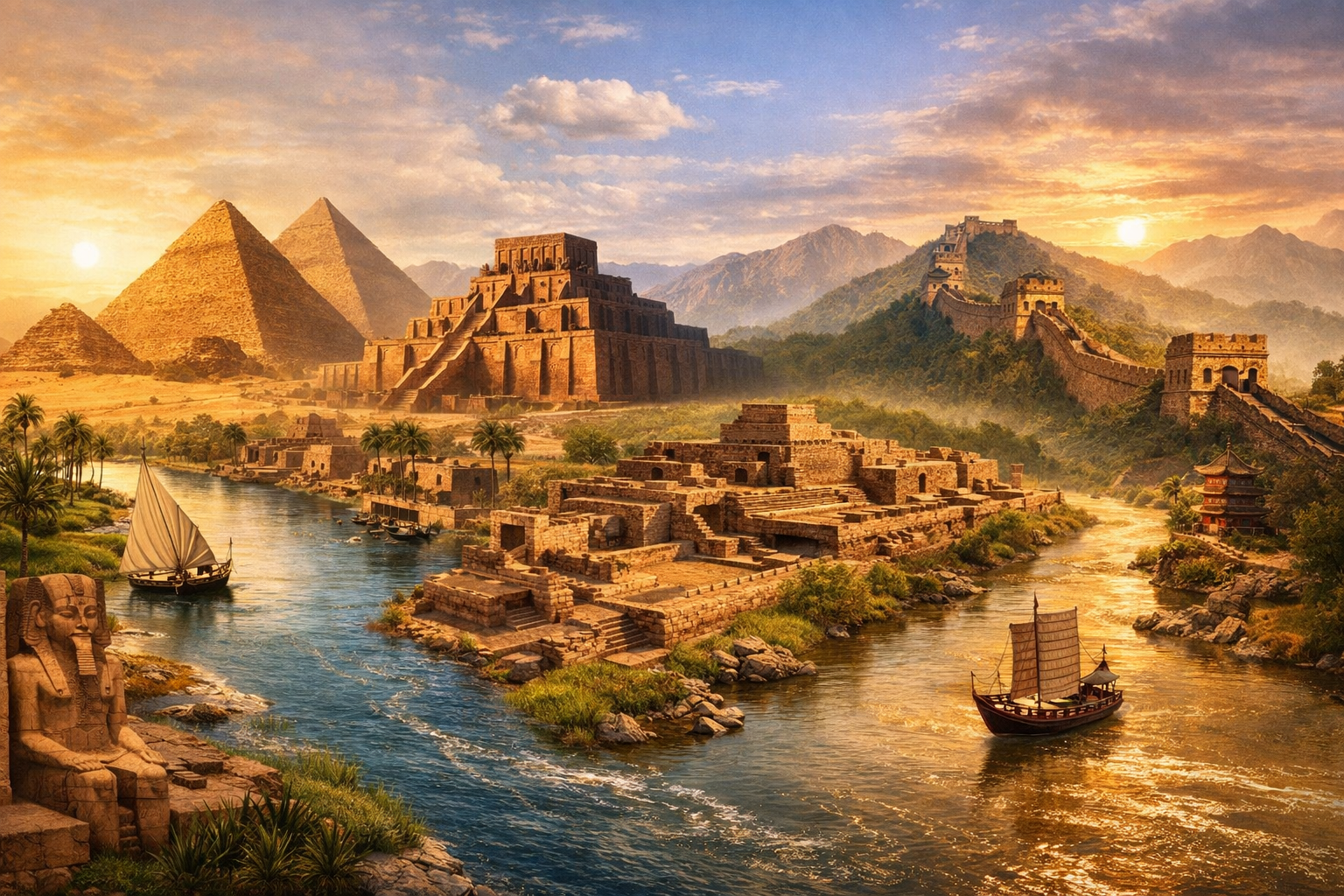


civilization did not begin with a decision, nor were the first cities built according to pre‑drawn maps. Life emerged instead wherever water flowed. There, on riverbanks, humans learned their first lessons of survival, then the first rules of stability, then the first outlines of social organization. Rivers were not merely watercourses, they were living pulses carrying within them the secret of man’s transformation from primitive wanderer into creator of civilization.
Contemplating the map of the ancient world reveals a striking truth: the greatest civilizations were not scattered without connection, but all arose around major rivers, as if responding to a hidden call guided by nature itself.
Water… when it becomes civilization
In an age that knew no technology and no engineering, the river was the first teacher.
From it, humans learned:
how to plant seeds,
how to wait,
and how to plan for the future.
The river does not give at random; it grants according to a pattern. Whoever understands this pattern survives and prospers.
Egypt… the miracle of the Nile
In the heart of the desert, where there was neither rain nor forest, the emergence of a great civilization seemed impossible… except for the Nile.
It was not merely a river; it was the rhythm of life. It came at its appointed time, overflowed, then receded, leaving behind land so fertile that it seemed reborn.
On its banks:
villages settled,
cities rose,
and the state was born.
Thus Herodotus spoke his famous line immortalized by history: “Egypt is the gift of the Nile.” Yet in reality, it was more than that; it was an ongoing dialogue between man and water.
Mesopotamia… between the Tigris and the Euphrates
If the Nile gave gently, the Tigris and the Euphrates tested humans.
Unexpected floods, shifting waters, and land that demanded constant effort.
But from the heart of this challenge, creativity was born.
Here, humans did not limit themselves to adaptation; they decided to gain control:
they dug canals,
built primitive dams,
and invented irrigation systems.
From this soil emerged the first laws, the first cities, and the earliest forms of administration. Civilization here was the fruit of a smart struggle with nature.
The Indus Valley… the calm of the Indus and the order of man
Far to the east, on the banks of the Indus River, a civilization appeared that was known not for wars or conquests, but for its order and precision.
Its cities were laid out as if designed by a modern engineering mind:
straight streets,
advanced drainage systems,
and a precise distribution of dwellings.
The river here was not merely a source of life, but an element in shaping a disciplined mind that saw stability as an opportunity for creativity rather than for conflict.
Ancient China… the wisdom of the Yellow River
The Yellow River, which gave China its life, was also a source of its anxiety.
Its devastating floods earned it the name “China’s Sorrow,” yet at the same time it was a harsh teacher of wisdom.
There, humans learned:
patience and balance, and
how to manage risk.
From this tension between gift and danger, one of the deepest and most enduring human civilizations was born.
Between geography and destiny
At first glance, it may seem that the clustering of these civilizations around rivers in roughly similar geographic regions was mere coincidence. Yet reality reveals a deeper law:
humans always seek wherever they can live… not merely survive.
In those regions, rivers provided:
continuous water,
fertile land,
and a climate that could be endured.
The natural result was that these banks became centers of human existence.
The river… memory and identity
The river was not just a resource; it became part of the people’s inner world.
In Egypt, it symbolized fertility and life.
In Mesopotamia, it was a force that had to be understood.
In China, it was a lesson in balance.
In the Indus Valley, it was the foundation of order.
The river shaped the human mind as much as it shaped the land.
When we read the history of civilizations, we ought not begin with kings or wars, but with water.
Rivers were not only arteries of life; they were the silent minds that taught humanity how to turn from a being who merely lived day to day… into a being who shaped its own future.
And on their banks, not only were cities built, but the greatest idea in human history was born:
that stability is the beginning of civilization, and that water is humanity’s first teacher


.jpg)